Saturday, September 20, 2014

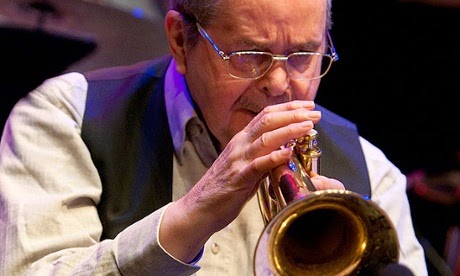
Kenny Wheeler: five of the jazz composer's greatest moments

John Fordham pays tribute to the late jazz composer by remembering some of the best works by a man who often underplayed his visionary abilities.
Kenny Wheeler, the great Canadian jazz composer and trumpeter who died this week aged 84 in his adopted London, was a very long way from loquacious. But when he did talk, he would get quickly to the point. In an interview with the Guardian on the eve of his 80th birthday tour, Wheeler memorably announced: “What I like doing best is writing sad tunes, and then letting wonderful musicians destroy them. I don’t want the players to try to interpret what they think I’m feeling.”

He once dismissed the talent that had turned his themes into globally performed jazz standards, and brought him world-class interpreters including Keith Jarrett, Jan Garbarek and Bill Frisell, as belonging to someone who “just takes pretty songs and joins them up.” Wheeler felt that a mix of visionary insights and shaky efforts to negotiate life on the artistic and economic margins often characterised jazz musicians, and it was no coincidence that his first big composing venture – 1968’s Windmill Tilter, for John Dankworth’s orchestra – was about Don Quixote, the legendary loser.

Here are some of the musician’s greatest moments from his career.

Sweet Dulcinea Blue

Wheeler came to London from Toronto in 1952, studied with Richard Rodney Bennett, became fascinated with the harmonies of classical composer Paul Hindemith, and played supple, succinct bebop trumpet in the 1960s with London jazz stars including the late Joe Harriott and Tubby Hayes, and free-improv with the pioneering Spontaneous Music Ensemble. In 1968, John Dankworth invited Wheeler to compose a suite for his all-star orchestra, at that time including such soon-to-be-luminaries as guitarist John McLaughlin and bassist Dave Holland. Above is a typical piece of early-Wheeler pensiveness from that session, Sweet Dulcinea Blue.

Gnu Suite

Wheeler was famously shy, hated listening to his own work, and was far too doubtful of his talents to grasp the baton of bandleading that Windmill Tilter had offered him. Seven years were to pass before he accepted another challenge to leave his regular role as an inspired improviser and enhancer of other people’s work - when ECM Records boss Manfred Eicher’s faith in him opened the next door, with 1975’s Gnu High session for the Munich company, fronting an A-list American trio of Keith Jarrett (piano), Dave Holland (bass) and Jack DeJohnette (drums).

Opening 

Wheeler made a string of superb albums for ECM in the 1970s and 80s, including Deer Wan (with Jan Garbarek) and Double, Double You (with Michael Brecker), but Music for Large and Small Ensembles, in 1990, was his biggest triumph – a fusion of North American folk music, abstract jazz, and imaginative expansion of the tone-palette and harmonic resources of a jazz lineup. As he was to do through much of his career, Wheeler used the voice of his friend and alter-ego Norma Winstone as an illuminating extra instrument. Here’s Opening, from Wheeler’s Sweet Time Suite.

Kind Folk 

Kenny Wheeler’s assessment of his talents as primarily about “pretty songs” was both a massive understatement and recognition of his unique melodic ear, the skill that led musicians of all persuasions and ages all over the planet to perform his music. Here’s a very famous one – with a title both true of Wheeler, and people he was happiest hanging out with – Kind Folk, from 1995’s Angel Song, with Lee Konitz on alto sax, Bill Frisell on guitar and Dave Holland on bass.

Everybody’s Song But My Own

But of all Kenny Wheeler’s compositions, it’s Everybody’s Song But My Own – the classic his sidemen liked to introduce as “Kenny’s hit” that has been the most widely played, and widely loved. Typical of Wheeler in imparting the sense of being sung even when it isn’t, joining playfulness and phlegmatic resignation, and sounding shapely and complete while remaining wide open for improvisers, it will be played by a lot of jazz musicians in a lot of far-flung places over the coming days. 

Friday, September 19, 2014

Jazz at Lincoln Center Opens Its Season at Rose Theater

Cuban music tends to involve a direct discussion: between voice and drums, between voice and chorus, between horn sections. Jazz tends to spread a discussion around, or build a hive of many discussions at once.

The explicit merger of the two traditions at Rose Theater on Thursday night both amplified and streamlined the discussion. The conversation made for an ambitious season-opening collaboration for Jazz at Lincoln Center between the pianist Chucho Valdés, the percussionist and singer Pedrito Martinez, the trumpeter and composer Wynton Marsalis and the Jazz at Lincoln Center Orchestra. The best parts of the sprawling suite were about calling the deities of the Santeria religion with six drumming hands and one clarion voice, and also about sound and resonance.

The two traditions are so interconnected in a general sense, through social and aesthetic history, that no part of either needs to be off the table for a project like this. The idea of big-band swing arrangements mixed with Afro-Cuban rhythm is about 70 years old, and Mr. Marsalis has dealt with that in many Jazz at Lincoln Center concerts. But there’s also a tradition of the religious chanting-and-drumming music of Santeria in a jazz-related context.

It might have started with Mr. Valdés’s father, Bebo, who in the early 1950s introduced the sacred double-headed batá drums into a jazz-influenced dance band at the Tropicana club in Havana, where he was musical director. Chucho did something similar, starting in 1972, including batá drums with jazz trio on his landmark record “Jazz Batá.”

More recently, the percussionist Román Díaz and the pianist David Virelles have been moving this tradition into avant-garde waters. Mr. Díaz, a teacher and elder among rumberos and Afro-Cuban drummers in New York, was there on Thursday, in the middle of a percussion trio with Clemente Medina on the left, and Mr. Martinez on the right. Wherever the music went, through the dynamics and virtuosity of Mr. Valdés or the jazz orchestra players, they were its cool-tempered power center.

The suite, called “Ochas,” after La Regla de Ocha, another name for Santeria, fell into eight parts dedicated to different orishas, or saints, in the Yoruba religion. Each part — for the trickster Elegua, the blacksmith Ogún, the elder Obatalá, and so on — started with an opening invocation and established its own distinct sound world, through Mr. Marsalis’s arrangements for standard jazz-band instrumentation; many of them rose to some sort of dramatic peak of drumming, chanting and improvising. As it stands, the suite is probably too long: 2 hours 45 minutes, with two intermissions. But it didn’t flag.

Universalizing jazz is Mr. Marsalis’s mission. And some of his writing in the first and second halves — an elegant, whirling language perhaps drawing on Ellington and Basie and Moacir Santos but pushed to original results — was a recognizable and nameable flag planting: Here stands jazz, and here stands Mr. Marsalis’s compositional style.

When that style retreated a bit, and the arrangements simplified, narrowing down into six-eight grooves and call-and-response riffs, modes and vamps built on perfect fourths — at times not far from middle-period Coltrane — the music grew into something greater.

Mr. Valdés boosted the energy for a few of those passages, making the piano talk with great, hard, ringing chords and single notes like rapid-fire arrow shots. The force and charisma in his technique never really get old. (Despite top billing on the program, he wasn’t onstage for very long; the orchestra’s regular pianist, Dan Nimmer, took over for most of the concert, playing with far more neutral affect.)

The program notes could have been a book. This is a world of contexts: those of the three principal musicians, as well as the meanings of various rhythms, Lucumí chants and movements in Santeria. But when Mr. Martinez opened his mouth to sing — in the invocations for each part of the suite, and in the musical discussions that followed with chorus singers and the orchestra — no context was needed to understand the power of his voice slicing through a mass of sound, his phrasing intricately weaving through the rhythmic accents.

Friday, September 12, 2014

Fall arts preview 2014: Pop music and jazz listings

A look at notable concerts and albums in pop and jazz.

Linkin Park, 30 Seconds to Mars, AFI

Sept. 15

Three bands from the upper tiers of today's hard rock team up for a big triple bill. Linkin Park has a new album, "The Hunting Party," that strips off their electronics for a punk sound that owes more to Refused and Helmet than their rap-metal roots; Jared Leto has become a convincing frontman and multi-media mogul with the anthemic 30 Seconds to Mars; AFI has gone back to the darkness with its latest goth-punk platter, "Burials." Hollywood Bowl, 2301 N. Highland Ave., L.A.; $39.50-$159.50. www.hollywoodbowl.com

Neutral Milk Hotel, the Breeders, Daniel Johnston.

Sept. 18

Three vastly different brands of 1990s-born indie rock, this Bowl bill is headlined by the Southern cult band Neutral Milk Hotel. Purveyors of powerful, imaginative guitar music with a psychedelic bent, the group has returned after dormant years in which its stature has greatly expanded. Ditto the Breeders, the beloved project of twins Kim and Kelley Deal, the former of the Pixies; and Daniel Johnston, the Texas songwriting legend whose magnificent creativity has over the years been at constant struggle with mental health issues. Hollywood Bowl, 2301 N. Highland Ave., Los Angeles; $20-$58. www.hollywoodbowl.com

Katy Perry

Sept. 19-20


Perry's smash-hit goth-rap single "Dark Horse" was indeed the sleeper pick off her otherwise jubilant and redemptive album "Prism," which cemented her as one of pop's biggest forces on radio. But the deep cuts, like the disco-bouncy "Birthday" and '90s house-infused "Walking on Air," make it an unexpectedly rewarding listen. Staples Center, 1111 S. Figueroa St., L.A.; $29.50-$150.50. www.staplescenter.com

Sunset Strip Music Festival

Sept. 20-21

While the club circuit on the Strip has veered from new relevance (Goldenvoice taking over the Roxy) to tough times (Key Club shuttering), L.A.'s most famous mile of live music continues to host one of its biggest music festivals. This year it welcomes native sons Jane's Addiction, the delightfully kooky dance act Empire of the Sun, bluesy rockers Cold War Kids and many others. Sunset Boulevard between Clark Street and Doheny Drive, West Hollywood; $49.50-$249. ssmf.com

Wu-Tang Clan, Talib Kweli, Pharoah Monch, others

Sept. 21

Staten Island's finest rap team, Wu-Tang Clan, is responsible for some of the most searing and influential hip-hop of the 1990s and '00s. The nine-member group, featuring RZA, GZA, Ghostface Killah, Method Man and others, has reunited to celebrate its legacy. Also on the bill are fellow New Yorkers Talib Kweli (a recent newsmaker due to an on-air argument from Ferguson, Mo., with CNN's Don Lemon) and Pharoah Monch, as well as L.A. rappers Ras Kass and Casey Veggies. The Forum, 3900 Manchester Blvd., Inglewood. www.ticketmaster.com

Album: Aphex Twin, "SYRO" (Warp)

Sept. 22

The influential electronic music composer Richard D. James returns for his first album in 13 years. With the artist's gymnastic way with beats, electronic swooshes and memorable melody, the new work features the sampled voices of his family and is said to be the first of many new Aphex-related works to come.

Drake, Lil Wayne

Sept. 22.

The Canadian rapper Drake teams with his New Orleans label-mate (and label boss) Lil Wayne for a celebration of all things Young Money. Expect guests, hits, rap-alongs and tracks from throughout the tag-team lyricists and expert MCs' impressive careers. Hollywood Bowl, 2301 N. Highland Ave., L.A.; $39.50-$175. www.hollywoodbowl.com

Arca

Sept. 25

The Venezuelan-born, Brooklyn-based producer put his noisy, deconstrucive imprint all over two of the most compelling albums of recent months: Kanye West's "Yeezus" and FKA Twigs' "LP1." His way of crafting songs from shards of percussion and only brief flurries of melody can take a song and make it sound otherwordly yet still burn up a nightclub. First Unitarian Church, 2936 W. 8th St., L.A.; $24-$30. attheecho.com

King Crimson

Sept. 30

The masters of progressive rock, co-founded by the remarkable ax-man Robert Fripp, returns for a rare series of concerts with fellow members, including the excellent session bassist Tony Levin. Best known to a new generation for its Kanye West-sampled jam "Twentieth Century Schizoid Man," Crimson and Fripp are calling this the band's farewell tour. The Orpheum, 842 S. Broadway, L.A.; $45-$150. www.laorpheum.com

Lorde, Majical Cloudz

Oct. 6

New Zealand artist Lorde, a magnetic young singer and songwriter responsible for one of the best pop songs of the last few years, "Royals," returns for her biggest Los Angeles gig to date. Joining her will be the deep, curiously powerful singer Devon Welsh, who performs as Majical Cloudz. Greek Theatre, 2700 N. Vermont Ave., L.A.; $40-$65. www.greektheatrela.com

Sam Smith

Sept. 29-30

The young British soul singer pivoted off his great turn on Disclosure's "Latch" into a major pop career in his own right. Sure, his album "In the Lonely Hour" was more progressive in its sexual politics (Smith is gay and has been outspoken about it in interviews) than its production, but his rangy falsetto is earning a big fan base and lots of opportunities (it's rumored he's up to do the next James Bond theme). Greek Theatre, 2700 N. Vermont Ave., L.A.; $35-$45. greektheatrela.com

Album: Bob Dylan, "The Basement Tapes Raw: The Bootleg Series Vol. 11" (Columbia)

Nov. 30

While recovering from a motorcycle accident in 1967, Bob Dylan holed up with a band eventually dubbed the Band in Woodstock, N.Y. The result is some of Dylan's most breathtaking work and has become the stuff of legend. Part of a recurring series of Dylan rarities, this one gathers all the recordings, many of which have never officially been released.

The Weeknd, Schoolboy Q, Jhene Aiko

Oct. 9

Rarely does pure sexual nihilism sound as sweet as it down from the lips of Abel Tesfaye. His experimental R&B project the Weeknd has become a pop-crossover hit, and he brings two great peers along with him for this gig: L.A.'s chart-topping MC Schoolboy Q and the enticing vocalist Jhene Aiko. Hollywood Bowl, 2301 N. Highland Ave., L.A.; $29.50-$89.50. hollywoodbowl.com

Tom Petty & the Heartbreakers

Oct. 10-11

Petty proved classic rock can still top the charts when his latest album, "Hypnotic Eye," landed atop the Billboard charts. It was a solid, well-written platter of sturdy Petty material, but there's still nothing like a group chorus of "Free Falling" with thousands of fellow travellers. The Forum, 3900 W. Manchester Blvd., Inglewood; $51.50-$151.50. ticketmaster.com

Supersonico

Oct. 11

Cafe Tacvba, Calle 13, Bomba Estéreo and Ana Tijoux are among the many alt-Latino artists heading up this ambitious, scene-defining mini-festival. Come early for the rowdy rap of Los Rakas and the politically charged Latin soul of La Santa Cecilia. Shrine Expo Hall, 665 W. Jefferson Blvd., L.A.; $46. goldenvoice.com

Festival Supreme

Oct. 25

Last year's debut of this music-and-comedy shindig (hosted by Jack Black's Tenacious D) at the Santa Monica Pier got pretty crowded. This edition should ease up on that with a new location and a comprehensive bill: $95.50. Fred Armisen, Eric Andre, Maria Bamford and the great parodist Dr. Demento are among the many musically versed comedians here. Shrine Expo Hall, 665 W. Jefferson Blvd., L.A.; $95.50. goldenvoice.com

JAZZ

Sept. 16

Known for occasionally performing in a giant Fats Waller mask, one of the top keyboard talents in jazz offers a tribute that lives up to its name with contributions from Meshell Ndegeocello and others.

The Angel City Jazz Festival

Sept. 19-28

The most forward-looking improvised music gathering in town keeps churning ahead with a broad menu of live sets with established and up-and-coming greats that includes Allison Miller, Craig Taborn, Wadada Leo Smith, Matana Roberts, Aruán Ortiz, Azar Lawrence and 2013 NEA Jazz Master Anthony Braxton.  www.angelcityjazz.com for details on times, tickets and venues.

Album: Sun Ra, "Sun Ra + His Arkestra: In the Orbit of Ra" (Strut)

Sept. 23

A new compilation assembled by Sun Ra Arkestra bandleader Marshall Allen in honor of what would have been the 100th birthday of the famed Spaceways Traveler features works from the '60s through the '80s.

Album: John Coltrane, "Offering: Live at Temple University" (Resonance)

Sept. 23

A long-buried treasure for fans of the saxophone giant, this often-bootlegged 1966 live recording taken just nine months before Coltrane's death features his wife, Alice, saxophonist Pharoah Sanders and a cast of surprise walk-ons in a chronicle of raw, unfettered expression and exploration.

Mark Turner Quartet

Sept. 28

A patient, lyrical saxophonist who has performed with the Fly Trio, Billy Hart and the SFJazz Collective, Turner performs from his new album, "Lathe of Heaven," his first recording as a leader since 2001. The Eyde at the Broad Stage, 1310 11th St., Santa Monica; $35. (310) 434-3200, www.thebroadstage.com

Joshua Redman Trio

Sept. 29

In the wake of the invigorating new live album, "Trios Live," the saxophonist launches a U.S. tour in Hollywood joined by Reuben Rogers on bass and Gregory Hutchinson on drums. Catalina Bar & Grill, 6725 Sunset Blvd., Los Angeles; $25-$30. (323) 466-2210, www.catalinajazzclub.com

Omaha Diner

Nov. 5

A wry jazz-funk supergroup featuring Skerik, Bobby Previte, Charlie Hunter and Steven Bernstein, Omaha Diner promises rowdy covers of pop's No. 1 hits, including "Single Ladies," "War" and "Thrift Shop." Catalina Bar & Grill, 6725 Sunset Blvd., Los Angeles; $20. (323) 466-2210, www.catalinajazzclub.com

Miguel Zenón

Nov. 15

The fiery saxophonist continues to carve a brilliant path along the intersection of Afro-Caribbean music and jazz with a new album forged by the Puerto Rican immigrant experience, "Identites Are Changeable." The Broad Stage, 1310 11th St., Santa Monica; $35. (310) 434-3200, www.thebroadstage.com

Marc Ribot

Nov. 21

The category-defying guitar virtuoso offers two sides of his talent in a set drawing from his evocative solo recording "Silent Movies" and his dazzling Cuban jazz group, Los Cubanos Postizos. Royce Hall, UCLA, 340 Royce Drive, Westwood; $22.85-$67. (310) 825-4401, cap.ucla.edu
Monday, September 8, 2014

Gerald Wilson dies at 96 multifaceted jazz musician

Gerald Wilson, a bandleader, trumpeter, composer, arranger and educator whose multifaceted career reached from the swing era of the 1930s to the diverse jazz sounds of the 21st century, has died. He was 96.
Wilson, who had been in declining health, died Monday at his home in Los Angeles, two weeks after contracting pneumonia, said his son, jazz guitarist Anthony Wilson.

In a lifetime that spanned a substantial portion of the history of jazz, Wilson's combination of articulate composition skills with a far-reaching creative vision carried him successfully through each of the music's successive new evolutions.

He led his own Gerald Wilson Orchestras — initially for a few years in the mid-1940s, then intermittently in every succeeding decade — recording with stellar assemblages of players, continuing to perform live, well after big jazz bands had been largely eclipsed by small jazz groups and the ascendancy of rock music.

Seeing and hearing Wilson lead his ensembles — especially in his later years — was a memorable experience for jazz fans. Garbed in well tailored suits, his long white hair flowing, Wilson shaped the music with dynamic movements and the elegant grace of a modern dancer.

Asked about his unique style of conducting by Terry Gross on the NPR show "Fresh Air" in 2006, he replied: It's "different from any style you've ever seen before. I move. I choreograph the music as I conduct. You see, I point it out, everything you're to listen to."

That approach to conducting, combined with the dynamic quality of his music, had a significant impact on the players in his ensembles.


"There's no way you can sit in Gerald's band and sit on the back of your chair," bandleader/arranger John Clayton told the Detroit Free Press. "He handles the orchestra in a very wise and experienced craftsman sort of way. The combination of the heart and the craft is in perfect balance."

Wilson's mastery of the rich potential in big jazz band instrumentation was evident from the beginning. Although he was not pleased with his first arrangement — a version of the standard "Sometimes I'm Happy" written in 1939, when he was playing trumpet in the Jimmie Lunceford band — he was encouraged by Lunceford and his fellow players to write more. "Hi Spook," his first original composition for big band, followed and was quickly added to the Lunceford repertoire. Soon after, Wilson wrote a brightly swinging number titled "Yard Dog Mazurka" — a popular piece that eventually became the inspiration for the Stan Kenton hit "Intermission Riff." It was the beginning of an imaginative flow of music that would continue well into the 21st century.

Always an adventurous composer, Wilson's big band music often had a personal touch, aimed at displaying the talents of a specific player, or inspired by many of his family members. After marrying his Mexican American wife, Josefina Villasenor Wilson, he was drawn to music possessing Spanish/Mexican qualities. His "Viva Tirado," dedicated to bullfighter Jose Ramon Tirado, became a hit for the Latin rock group El Chicano and was one of several compositions celebrating the achievements of stars of the bullring.

"His pieces are all extended, with long solos and long backgrounds," musician/jazz historian Loren Schoenberg told the New York Times in 1988. "They're almost hypnotic. Most are seven to 10 minutes long. Only a master can keep the interest going that long, and he does."

In addition to his compositions, Wilson was an arranger with the ability to craft songs to the styles of individual performers, as well as the musical characteristics of other orchestras. It was a skill that kept him busy during the periods when he was not concentrating on leading his own groups.

"I may have done more numbers and orchestrations than any other black jazz artist in the world," he told the Los Angeles Sentinel. "I did 60-something for Ray Charles. I did his first and second country-western album. I wrote a lot of music for Count Basie, eight numbers for his first Carnegie Hall concert," he said.

He also provided arrangements and compositions for such major jazz artists as Duke Ellington, Dinah Washington, Billie Holiday, Sarah Vaughan, Dizzy Gillespie, Ella Fitzgerald, Nancy Wilson and others, as well as — from various genres — Bobby Darin, Harry Belafonte, B.B. King and Les McCann.


Wilson's longstanding desire to compose for symphony orchestra came to fruition with "Debut: 5/21/72," commissioned for the Los Angeles Philharmonic in 1972 by the Philharmonic's musical director, Zubin Mehta. His "Theme for Monterey," composed as a commission by the Monterey Jazz Festival in 1997, received two Grammy nominations. In 2009, on his 91st birthday, he conducted the premiere of his six-movement work, "Detroit Suite," a tribute to the city in which his music career began, commissioned by the Detroit International Jazz Festival.

Gerald Stanley Wilson was born Sept. 4, 1918, in Shelby, Miss. He began to take piano lessons with his mother, a schoolteacher, when he was 6. After purchasing an instrument from the Sears Roebuck catalog for $9.95, he took up the trumpet at age 11. The absence of a high school for African Americans in segregated Shelby made it necessary for him to begin his secondary school studies in Memphis. But a trip with his mother to the Chicago World's Fair in 1933 stimulated a desire to move north, and he was sent to live with friends in Detroit, where he attended and graduated from the highly regarded Cass Technical High School.

An adept trumpeter while still in his teens, Wilson played at Detroit's Plantation Club before joining the Chic Carter Band touring band. In 1939 he replaced trumpeter-arranger Sy Oliver in the Jimmy Lunceford Orchestra, then one of the nation's most prominent swing bands.

Wilson served in the U.S. Navy at the Great Lakes Naval Training Center during World War II, then moved to Los Angeles, forming his own big band in 1944. Despite the band's almost immediate success, with nearly 50 recorded pieces and a string of national bookings in its first years of existence, Wilson was not satisfied with his own personal level of craftsmanship. He disbanded the ensemble to spend a few years filling in what he believed were gaps in his music education. He also went on the road with the Count Basie Band and Dizzy Gillespie's group.

Throughout the 1950s and '60s, Wilson was an established participant in L.A.'s busy music scene, arranging, composing for jazz and pop singers, big bands, films and television, while continuing to be active with his own orchestra. Eager to pass on his knowledge and experience, he taught jazz courses at what is now Cal State Northridge, Cal State L.A. and UCLA, and had a radio program on KBCA-FM (105.1) from 1969 to 1976.

As he moved into his 60s, Wilson viewed the commercial activity of his earlier years as the foundation that allowed him to concentrate on his creative efforts.

He had worked hard, he told the Boston Globe, so that in his later years he would no longer "have to go hustling any jobs. I have written for the symphony. I have written for the movies, and I have written for television. I arrange anything. I wanted to do all these things. I've done that. Now I'm doing exactly what I want, musically, and I do it when I please. I'm a musician, but first and foremost, a jazz musician."

Besides his wife and his son, Wilson is survived by daughters Jeri and Nancy Jo, and four grandchildren.

Monday, August 25, 2014

MOJO to celebrate music of the 'First Ladies of Jazz' Music Tonight

Monday is ladies' night for the Mystic Order of the Jazz Obsessed.

The August edition of MOJO's monthly Jazz Jambalaya series spotlights the "First Ladies of Jazz" with a program featuring vocalist Kathy Lyons. Lyons will sing selections made famous by the likes of Billie Holiday, Ella Fitzgerald, Sarah Vaughan, Anita O'Day and Diana Krall.
Lyons will be backed by a band including Gino Rosaria, JoJo Morris and Bryan Morris. The program will feature narration by John Nodar.

The event starts at 6:30 p.m. Monday, Aug. 25, at the Gulf City Lodge, 601 State St. in downtown Mobile. Admission is $8 for MOJO members, $12 for nonmembers; student and military rates are available. The price includes a light jambalaya dinner.

For more information, call 251-459-2298, e-mail mobilejazz@bellsouth.net or go to www.mojojazz.org.

Saturday, August 23, 2014

James Morrison and Emma Pask celebrate 20 years of making Jazz Music

Their friendship has outlasted many marriages, so it's understandable that jazz artists James Morrison and Emma Pask have taken to the road to celebrate their 20-year alliance.
The jazz trumpet star and the singer love to retell the story of how Morrison plucked a 17-year-old Pask from her school band at Kirrawee High in Sydney's south to perform on stage with him afterwards.

"I thought he was staring because my shirt was untucked – I was always getting in trouble for that," says Pask, now 37. Instead, the jazz veteran had been blown away by Pask's voice and that night was the start of a partnership that has taken the pair all over the world to perform to packed venues.

Says Pask: "When I want to annoy him I say he's a father figure, but really he's more like a big brother – a musical and life mentor. He's guided me through some ups and downs and we know each other inside out."

Their current tour, which has already taken them to Brisbane and Melbourne, combines their talents with a full big band and swing classics from Gershwin, Miller, Sinatra and Ellington.

Morrison is relishing the experience. "As far as jazz goes, this is as big as it gets," he says. "I don't know an artist who doesn't get a smile on their face when a big band fires up behind them."

He says he and Pask, who he says is like his "little sister",  can't wait to play the Sydney show. "It's home for both of us. It's going to be a good time."

James Morrison and his Big Band Tour is at Sydney Town Hall, Saturday 20 September 7.30pm

Read more: http://www.smh.com.au/lifestyle/celebrity/james-morrison-and-emma-pask-celebrate-20-years-of-making-jazz-music-20140821-106k7a.html#ixzz3BTt4O1fe

Friday, August 22, 2014

The Old Duke Jazz Festival over the Bank Holiday weekend in Bristol

The Old Duke Jazz Festival has been an annual highlight for Bristol music lovers for the best part of four decades and this weekend's three-day event promises to be better than ever.

The King Street pub has long been one of the city's most important musical landmarks and the annual festival on the cobbles between the Old Duke and the equally famous Llandoger Trow pub opposite pulls together a line-up featuring many of the bands that perform at the Old Duke throughout the year.

This weekend's line-up includes a combination of old favourites like The Blue Notes, The Severn Jazzmen, Eddie Martin's Blues Band and The Robin Reece Jazz Band, alongside more recent additions to the weekly programme like Fromage en Feu, who make their festival debut.

Old Duke landlord Stuart Seydel has been running the festival since he took over the pub 13 years ago and, although he admits it's not easy to organise, he says it's still worth the hard work and late nights involved.

Stuart says: "The festival has been going for nearly 40 years now and we've had some brilliant performers, including the legendary Acker Bilk, so I think its history plays a major role in its popularity, plus the fact it's free.

"Since I took over 13 years ago, the festival has grown, but we've had to scale it back over the last few years as it was getting too big for the space.

"The bands are largely bands who play regularly at the Duke, with occasional special guests, but ultimately the festival is about the Duke and a showcase of what we do here every night of the week, all year round."

The Old Duke continues to be an important hub for the city's jazz and blues musicians and Stuart says the scene is getting better all the time, with new bands coming through.

"There are some great young jazz bands coming through at the moment. There are people such as James Morton, who play modern jazz, but also bands playing more traditional jazz such as The Rhythm Pencils and Jazz Disaster.

"The trad jazz is still very important to us; it's what the pub, and therefore the festival, is all about. You just need to look at the posters on the walls and ceiling in the pub to know that.

"There are some great new trad jazz acts coming through and I think the style will stay around for a long time yet. One of the highlights of this year will be Sinead McCabe, who will be singing with Cass Caswell's New Orleans Update on the Monday evening. Sunday night headliner Eddie Martin is also always worth seeing."

For musician and singer Eddie Martin, who has been running a regular Sunday blues night at the pub for more than 20 years, the Old Duke has become a second home, when he's not touring the world with his band.

Eddie says: "The Old Duke has always been a fantastic and unique music venue. It is the closest thing me and several of my touring international musician friends have experienced to the vibe of New Orleans.

"Good music, energetic appreciative party-spirit fans and an all-inclusive everyone- is-welcome atmosphere: I love it.

"Stu the landlord is great at keeping this alive through recruiting like-minded, personable and friendly staff and making it better every year."

For jazz musician Jeremy Huggett, the Old Duke has been a big part of his life since he was a baby. In fact, he claims his love of jazz music stems from the fact he was still in the womb when his mother used to go to the pub to hear his father playing clarinet and sax at the venue.

As a child, he went to the Old Duke to see his dad perform and later started working at the pub collecting glasses, before serving behind the bar and eventually becoming the assistant manager in 1990.

Jeremy made his musical Old Duke debut guesting with his father's band, the Severn Jazzmen, when he was aged 14. Since then, he has become one of the jazz scene's most in-demand musicians, playing with famous names all over the country, including Acker Bilk, Digby Fairweather, George Melly and Humphrey Lyttleton.

Jeremy has played at every Old Duke Jazz Festival since 1998 and this year is bringing one of his newest bands, The Harlem 5, to the event. Playing a mixture of jazz, swing and blues, they close the festival on Monday.

He says: "The Old Duke holds a special place in my heart and, out of all the different venues I have played both in the UK and abroad, it's still my favourite. It feels like coming home."